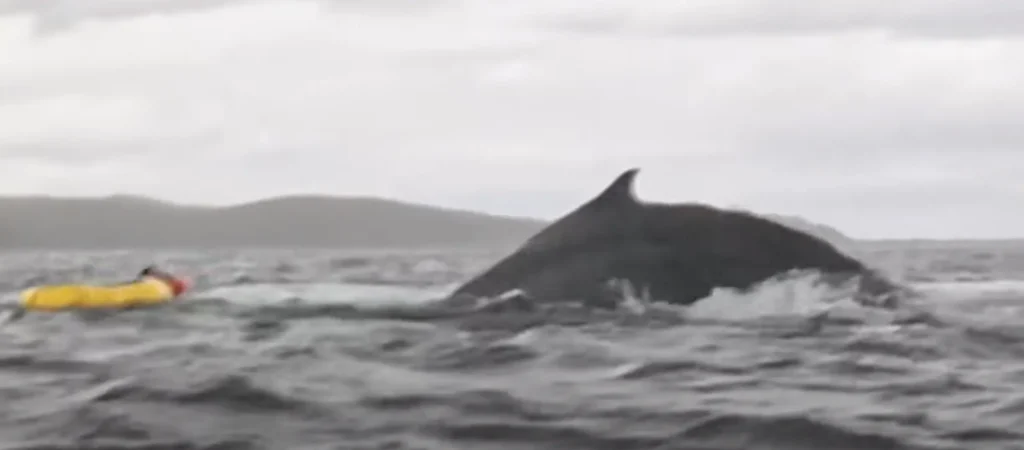
-And then spat him out of course.
A curious humpback whale off the coast of Chilean Patagonia did what any baby going through its oral phase would do, and when an unfamiliar kayaker approached her, she simply put him in her mouth.
“I closed my eyes, and when I opened them again, I realised I was inside the whale’s mouth. I felt a slimy texture brush my face,” the 23-year-old told BBC, adding that all he could see was dark blue and white.
“I wondered what I could do if it had swallowed me since I could no longer fight to stop it. I had to think about what to do next.”
But within seconds, Adrián started to feel as though he was rising toward the surface.
“I was a little afraid of whether I would be able to hold my breath because I didn’t know how deep I was, and I felt like it took me a long time to come up.
“I went up for two seconds, and finally I got to the surface and realised that it hadn’t eaten me. When I got out I understood that, of course, it was probably out of curiosity that the whale had approached me, or maybe to communicate something.”
Just some meters away in another kayak, Adrián’s father Dall Simancas watched on in disbelief.
He suddenly heard a crash behind him. “When I turned around, I didn’t see Adrián.”
“I was worried for a second, until I saw him coming up out of the sea,” the 49-year-old said.
“Then I saw something, a body, which I immediately interpreted as most likely being a whale because of its size.”
According to wild life expert Roched Jacobson Seba, Humpback whales have narrow throats “about the size of a household pipe” designed for swallowing small fish and shrimp,
“They physically cannot swallow large objects like kayaks, tires, or even big fish like tuna. Ultimately, the whale spit out the kayak because it was physically impossible to swallow.”
“The whale was likely feeding on a school of fish when it unintentionally scooped up the kayak along with its meal. When whales surface too quickly while feeding, they can accidentally hit or engulf objects in their path.”
“Boats used for whale watching and research must always keep their engines on,” he added, as the noise helps whales detect their presence.
So there you go; Next time you go kayaking don’t forget to bring your obnoxious bluetooth speaker and blast some heavy music!